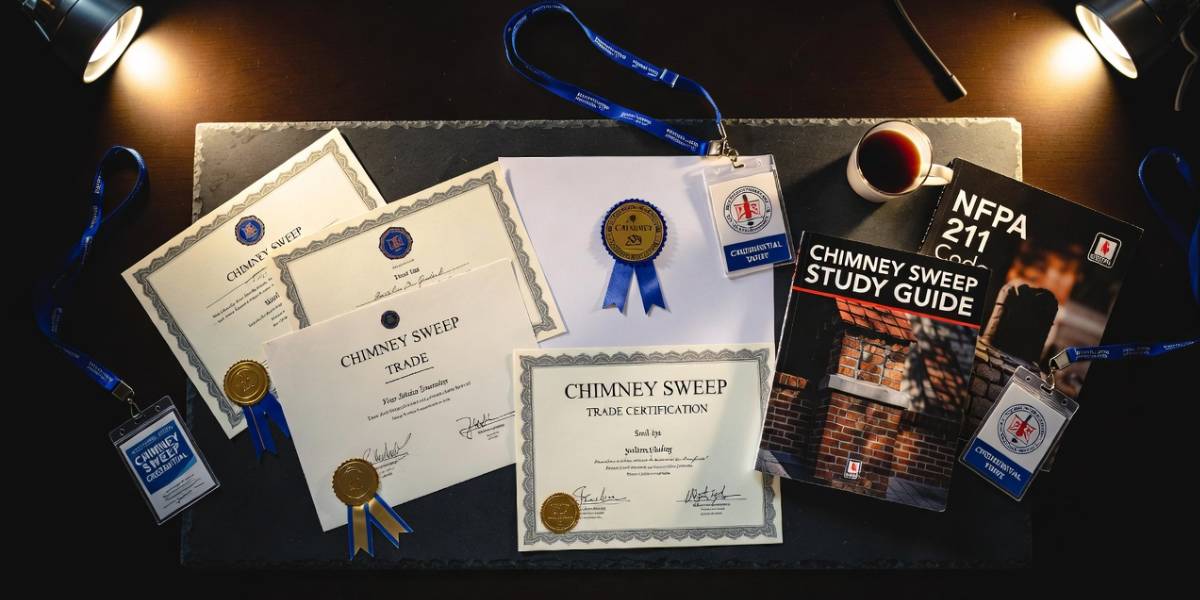
Most people think about certifications as checkboxes. Get the cert, put the letters after your name, move on. That's backwards.
In the chimney trade, certifications aren't trophies — they're layers of credibility that compound. Each one opens doors that the previous one can't. Get them in the wrong order and you waste money. Skip the important ones and you lose jobs to sweeps who didn't. Stack them deliberately and you build a professional reputation that takes years to replicate.
Here's the stack, in order, with honest assessments of what each one costs, what it actually requires, and what it does for your business.
Layer 1: CSIA Certified Chimney Sweep — The Foundation
What It Is
The Certified Chimney Sweep (CCS) credential from the Chimney Safety Institute of America is the baseline professional certification for the trade. It's nationally recognized, referenced by insurance companies, listed in consumer directories, and understood by real estate agents and home inspectors as the minimum standard of professional competence.
It is not a license. It does not give you legal authority to operate in any jurisdiction. What it gives you is something harder to quantify but equally important: the ability to prove you studied the standards and passed an exam that most people can't walk into cold.
What's On the Exam
The CCS exam draws from three core references:
- NFPA 211 — The national standard for chimneys, fireplaces, vents, and solid fuel-burning appliances. This is the document that defines inspection levels, installation requirements, clearances, and maintenance standards for every chimney system type.
- International Residential Code (IRC), Chapter 10 — The building code chapter covering chimneys and fireplaces. Originally reorganized along NFPA 211 lines in 1995, the IRC is what building inspectors enforce. Understanding both the standard and the code — and where they align and diverge — is fundamental.
- Successful Chimney Sweeping (or the Chimney and Venting Essentials Manual) — The practical operations manual covering day-to-day sweeping procedures, equipment use, and field techniques.
This isn't a weekend-course-and-you're-done situation. The material is dense. You need to understand masonry construction, factory-built chimney systems, clearance requirements, connector installation, creosote science, and the three levels of chimney inspection. People who don't study fail the exam.
How to Get It
There are several paths to the exam:
- SureFire Training Academy — 100% online, self-paced. Five lessons covering the core material. You read the assigned chapters, work through presentations, and take quizzes. This is the most accessible option for someone already working and studying in the evenings.
- CSIA Six-Day Training School — Hands-on classroom program. The most comprehensive but also the most expensive and time-consuming. Good if you want immersive instruction and have a week to dedicate.
- In-person review sessions — Shorter intensive reviews, often held at industry conferences or regional meetings.
- Self-study + exam — Buy the reference materials, study on your own, sit for the proctored exam. Possible but harder without structured guidance.
What It Costs
| Item | Cost |
|---|---|
| Review course (online or in-person) | $300 – $500 |
| Exam fee (often included with review) | Included or ~$150 |
| Annual certification maintenance | $249/year |
| Renewal every 3 years (review course or CEUs) | $200 – $400 |
What It Does for Your Business
Practical advantages that translate directly to revenue:
- CSIA directory listing. When homeowners search the CSIA website for "certified chimney sweep near me," you show up. This is free, qualified lead generation.
- Insurance company requirements. Many commercial clients, property management companies, and insurance carriers require a CSIA-certified sweep. Without it, you're excluded from those jobs entirely.
- Real estate referrals. Agents recommend certified sweeps because it reduces their liability. "I referred a certified professional" is their cover.
- Google review differentiation. "CSIA Certified" in your business listing signals legitimacy. In an industry plagued by scam operators, this matters more than you'd think.
- Customer trust. When you explain a finding and back it with "this is documented per NFPA 211 Section 15.4.2" — and the customer sees your certification on the wall of your van — they're more likely to trust your assessment than question your motives.
Here's something the industry doesn't advertise loudly: sometimes only the owner of a company is CSIA certified while uncertified technicians are sent to do the actual work. When a customer hires a "CSIA Certified" company, they may not be getting a certified inspector. As a solo operator, your CCS is your credential on every job. That's a competitive advantage worth stating explicitly.

Progression Within CSIA
The CCS isn't the ceiling — it's the floor. CSIA has a deliberate progression system:
| Level | Requirements | What It Signals |
|---|---|---|
| Certified Chimney Sweep (CCS) | Pass the exam | You know the standards |
| Specialist | CCS for 3+ years + 4 continuing education classes | You've invested in ongoing learning |
| Master | CCS for 9+ continuous years (or 18 non-continuous) + 6 CEU classes + active NFI certification | You're an authority in the trade |
The Master designation is genuinely hard to achieve. It requires nearly a decade of continuous certification plus specialty credentials. If you're planning a career in this trade — not just a job — the Master track is the long game that positions you as an expert witness, trainer, and industry leader.
Layer 2: NFI Certifications — The Revenue Multipliers
What They Are
National Fireplace Institute (NFI) certifications cover specific appliance types:
- NFI Gas Specialist — Gas fireplaces, inserts, stoves, and log sets
- NFI Wood Specialist — Wood-burning fireplaces, inserts, and stoves
- NFI Pellet Specialist — Pellet stoves and inserts
Where the CCS proves you understand chimney systems broadly, NFI certifications prove you understand specific appliance installation and service. They're more advanced, more technical, and directly tied to higher-revenue work.
Why They Matter for Revenue
Consider the revenue difference between a cleaning-only sweep and one who can install and service appliances:
- A chimney cleaning pays $150–$400. You can do 3–4 per day.
- A fireplace insert installation pays $1,500–$6,000. It takes a full day but generates more revenue than an entire week of cleanings.
- Gas appliance servicing pays $80–$200 per unit and fills the off-season schedule when wood-burning work dries up.
NFI certification is what allows you to do this work credibly — and in some jurisdictions, legally. Manufacturers often require NFI-certified installers for warranty coverage. Property managers and commercial clients require it for liability reasons.
Which NFI cert to get first: Start with Gas or Wood based on your market. If your area has a lot of gas fireplaces and inserts (common in newer suburban developments), Gas Specialist opens more doors. If your market skews toward older homes with traditional wood-burning fireplaces, Wood Specialist makes more sense. Either way, the first one teaches you the framework — subsequent specializations go faster.
NFI + CCS = Required for Master Designation
Remember the CSIA progression? You need an active NFI certification to achieve the Master Chimney Sweep designation. The two certification bodies are designed to complement each other: CCS covers the chimney system, NFI covers the appliance. Together, they cover the complete picture.
Layer 3: NFPA 211 — The Standard You'll Live By
Not a Certification, But Essential Knowledge
NFPA 211 isn't a certification you earn — it's the standard that governs everything you do. You'll reference it on every inspection report, every repair estimate, and potentially in court if your work is ever questioned.
Understanding NFPA 211 deeply — not just passing an exam that covers it — is what separates a competent sweep from a dangerous one.
The Three Inspection Levels
NFPA 211 Chapter 15 defines three levels of chimney inspection. Understanding these isn't academic — it's directly tied to what you can charge and what you're liable for:
| Level | When Required | What's Included | Typical Fee |
|---|---|---|---|
| Level 1 | Annual routine inspection; continued service, no changes | Visual exam of readily accessible portions — firebox, damper, visible flue from below, ground-level exterior | $100 – $250 (often bundled with cleaning) |
| Level 2 | Property sale/transfer, fuel type change, appliance replacement, after chimney fire or weather event | Everything in Level 1 + accessible attics/crawl spaces + clearance verification + mandatory video scan with chimney camera | $300 – $700 |
| Level 3 | When Level 1 or 2 suggests hidden hazard requiring concealed access | Everything in Levels 1 and 2 + targeted removal of building components to access concealed areas | $1,000 – $5,000+ |
There is no such thing as a Level 2 inspection without a camera. NFPA 211 is explicit: Level 2 requires examination of internal flue surfaces with image scanning equipment or equivalent. Any inspector claiming to perform a Level 2 without video scanning is not meeting the standard. Period. This is one of the most commonly violated requirements in the trade, and it exposes both the sweep and the customer to liability.
Common Misunderstandings You Need to Clear Up
You'll encounter these misconceptions constantly — from customers, from real estate agents, and sometimes from other sweeps:
- "A chimney sweep IS an inspection." No. Sweeping removes deposits. Inspection is a diagnostic evaluation. They're separate services, though a Level 1 should accompany every cleaning.
- "Level 1 covers the whole chimney." No. Level 1 only covers readily accessible portions from the firebox area and ground level. Attics, crawl spaces, and internal flue surfaces are excluded.
- "If it passed last year, we're good." No. NFPA 211 requires annual inspection at minimum. Conditions change, materials deteriorate, animals nest.
- "A home inspector's chimney check equals a Level 1." No. Home inspectors perform a general visual assessment. A Level 1 requires a qualified chimney inspector with trade-specific knowledge.
- "Level 2 is optional during a home sale." While not universally enforced by statute, NFPA 211 requires Level 2 upon transfer of property. This is the recognized standard of care — and the standard you'll be measured against if something goes wrong.
Why Deep NFPA 211 Knowledge Protects You
Documentation is the chimney sweep's best legal defense. When you write "cracked flue tile observed at approximately 8 feet above the smoke chamber, per NFPA 211 Section 15.4, this condition warrants repair before continued use" — you've done three things:
- Identified the problem with specificity
- Referenced the governing standard
- Made a clear recommendation in writing
If that chimney later has a fire and the homeowner didn't act on your recommendation, your documentation protects you. If you documented nothing, or documented vaguely, or didn't reference the standard — you're exposed. Lawsuits in this industry can reach into the millions. A $4 million case was filed when a client's property caught fire and the plaintiffs blamed the sweep company for inadequate maintenance guidance.
Your understanding of NFPA 211 isn't just professional knowledge — it's your liability shield.
Layer 4: State and Local Licensing — The Wild Card
The Uncomfortable Truth
There is no federal license requirement for chimney sweeping in the United States. In most states, there isn't a state-level requirement either. That means — legally — anyone can buy a brush and call themselves a chimney sweep.
This is both a feature and a bug of the trade. Low barrier to entry means you can start working relatively quickly. But it also means you're competing with unlicensed operators offering $49 "cleanings" to unsuspecting homeowners.
What You Actually Need to Research
Licensing requirements vary wildly by state and even by municipality. Here's what to investigate in your jurisdiction:
- Business license — Nearly universal. Required to operate a business in most cities and counties, regardless of trade.
- Contractor's license — Some states require a general contractor's license or specialty contractor's license for chimney work, especially for repairs and installations (as opposed to cleaning only).
- Fire code permits — Some jurisdictions require permits for chimney inspection or repair work. The Authority Having Jurisdiction (AHJ) — typically the local fire marshal or building department — determines this.
- Insurance requirements — Many jurisdictions require proof of insurance to operate. At minimum, you need General Liability ($1M per occurrence / $2–3M aggregate), Commercial Auto ($1M combined), and potentially Workers Compensation if you have any employees.
How to research your jurisdiction: Start with your state fire marshal's office. Then check your county and city business licensing requirements. Call the local building department and ask specifically about chimney sweep or chimney contractor licensing. Don't rely on generic "how to start a business" websites — they rarely cover trade-specific requirements. The NCSG (National Chimney Sweep Guild) maintains resources on state-level requirements for members.
NFPA 211 Adoption by State
Over 20 states have adopted NFPA 211 directly or by reference, including Colorado, Florida, Maryland, New York, Ohio, Oregon, Pennsylvania, Virginia, and Washington. Major cities including Los Angeles, Denver, Phoenix, Philadelphia, Seattle, and Portland have also adopted it directly.
Even in states that haven't formally adopted NFPA 211, the standard is widely recognized as the industry standard of care. Courts routinely reference it regardless of formal adoption status. If your work is ever questioned, NFPA 211 is the yardstick against which you'll be measured.
The Dryer Vent Add-On: CSIA C-DET
Worth Mentioning Separately
The Certified Dryer Exhaust Technician (C-DET) certification from CSIA is the only nationally recognized certification specifically for dryer vent service. It's recognized in all 50 states and operates on a three-year renewal cycle.
Dryer vent cleaning is a natural add-on for chimney sweeps — you already have the customer relationship, the scheduling infrastructure, and the general competence with air-movement systems. The numbers make it worthwhile:
- Dryer vent cleaning: $100–$250 per job
- Takes 30–60 minutes
- Year-round demand (not seasonal like chimney work)
- Nearly 16,000 dryer fires per year in the U.S. — customers are motivated when you explain the statistics
Adding C-DET to your credentials gives you another revenue stream that specifically addresses the slow months. When the chimney phone goes quiet in February, dryer vent work keeps the schedule filled.
What NOT to Waste Money On (Early)
Not every certification or training opportunity is worth your investment in the first few years. Here's what to skip until you're established:
- Franchise fees — Some chimney franchise operations provide training as part of their package, but you're paying for the franchise model, not just the education. The training component can be replicated independently through CSIA + NFI for a fraction of the cost.
- Drone certifications — An FAA Part 107 drone pilot certificate is interesting but niche for residential chimney work. Most residential inspections require interior camera work, not aerial imaging. Save this for when you have a commercial inspection operation.
- F.I.R.E. certification — Fireplace Investigation Research & Education certification is specifically for fire investigation and expert witness work. Valuable eventually, but you need years of field experience before it makes sense.
- Multiple NFI specializations simultaneously — Get one first. Learn the framework. Add others as your market demands them.
The Recommended Certification Timeline
Here's the order that maximizes both credibility and revenue at each stage:
| When | What | Why |
|---|---|---|
| Before you start | CSIA Certified Chimney Sweep (CCS) | Foundation. Directory listing. Insurance compliance. Customer trust. |
| Year 1 | C-DET (Dryer Exhaust Technician) | Off-season revenue stream. Low investment, immediate payback. |
| Year 2 | First NFI specialization (Gas or Wood) | Unlocks appliance installation/service revenue. Higher-ticket jobs. |
| Year 3+ | Second NFI specialization | Broader service menu. Moves toward Specialist/Master designation. |
| Year 3+ | NCSG membership + conference attendance | Network, CEUs, vendor relationships, industry intelligence. |
| Year 5+ | CSIA Specialist designation | Requires 3+ years CCS + 4 CEU classes. Shows commitment. |
| Year 9+ | CSIA Master designation | The pinnacle. Requires 9+ years CCS + 6 CEUs + active NFI. Expert territory. |
The NCSG: Certification and Professional Network
The National Chimney Sweep Guild (founded 1977) is both a professional organization and a certification body. The NCSG Certified Chimney Sweep credential is another valuable certification to have alongside your CSIA CCS. While CSIA certification is the most widely recognized baseline, the NCSG certification reinforces your credibility and demonstrates commitment to the profession from multiple angles. Having both signals to customers, insurance companies, and referral partners that you're serious about the trade.
Beyond certification, NCSG membership is where the industry connects. It gets you:
- The NCSG Certified Chimney Sweep credential — another layer of professional credibility
- Access to two annual conferences (NCSG Convention and Chimney Expo) with CEU-qualifying sessions
- Technical support from experienced professionals when you encounter something unfamiliar in the field
- Subscription to Sweeping Magazine — trade publication with technical articles and business insights
- Members-only discounts on business services, education, and insurance
- A network of peers who understand what you do
The trade publications are worth mentioning too: Sweeping Magazine (NCSG), The Chimney Sweep News (independent), and Blue Collar Magazine (reaching 6,000+ chimney and hearth professionals). Staying current with industry developments, product recalls, code updates, and business strategies is part of being a professional — not a luxury.
The Bottom Line
Certifications in the chimney trade aren't about collecting acronyms. They're about building a credibility stack that compounds over time:
- CCS gets you in the door. Customers trust you. Insurance companies accept you. Agents refer you.
- NFI gets you higher revenue. Appliance installation and service work pays more than cleaning. Significantly more.
- NFPA 211 knowledge keeps you safe. Safe from liability. Safe from making mistakes that hurt people. Safe from the courtroom.
- State licensing keeps you legal. Don't assume — research your jurisdiction specifically.
The sweep with CCS + NFI Gas + C-DET, deep NFPA 211 knowledge, proper insurance, and a clean Google Business Profile doesn't worry about the $49 Craigslist operator. They're playing a different game entirely.
Got the credentials. Now what?
Your certifications open doors, but your truck is your office. Let's set it up right.
Read: Your First Truck Setup →