
There's a rule in the chimney trade that every veteran sweep learns eventually — usually the hard way: if it isn't documented, it didn't happen.
You can perform a flawless inspection. You can identify every crack, every gap, every Stage 3 creosote deposit. You can explain the findings clearly, recommend the right repairs, and give the homeowner every opportunity to act. But if a fire happens six months later and you can't produce the report, the photos, and the signed acknowledgment? You were never there. Legally, you might as well have never climbed the ladder.
Documentation isn't paperwork for paperwork's sake. It's the single most important thing standing between your business and a lawsuit that could end it.
The Real-World Stakes
Here's what happens when a chimney fire occurs after a professional inspection:
- The homeowner's insurance company investigates.
- Your inspection report gets subpoenaed.
- If the report documented the deficiency and recommended repairs — you're generally protected.
- If the report missed the deficiency or didn't clearly communicate the risk — you face liability.
- If no documentation exists at all — you're extremely vulnerable.
This isn't hypothetical. A $4 million lawsuit was filed against a chimney sweep company when a client's property caught fire. The plaintiffs alleged the company failed to provide proper chimney maintenance instructions. The outcome hinged entirely on what was — and wasn't — in the documentation.
Liability in chimney fire cases can fall on the sweep for improper or inadequate cleaning, failure to detect an obvious hazard, or failure to properly communicate findings. Professional Liability (E&O) insurance covers these claims — but your insurer's ability to defend you depends on the paper trail you've built.
The Five Layers of Documentation
Think of documentation as layers of protection. Each one adds strength. Skip a layer, and the whole shield weakens.
Layer 1: Photo and Video Evidence
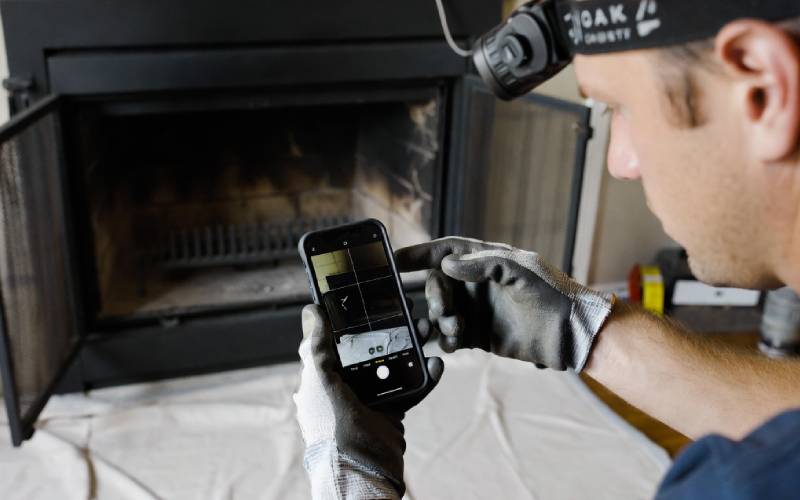
Your chimney camera and your phone are your most powerful legal tools. Every job should produce:
- Before photos — the condition of the firebox, damper, and visible flue before you start cleaning.
- During-inspection screenshots — camera inspection captures of cracks, gaps, deteriorated mortar, creosote buildup, missing liner sections, and moisture intrusion.
- After photos — post-cleaning condition showing the work was completed.
- Exterior documentation — crown condition, cap presence and condition, flashing, visible masonry deterioration.
- Deficiency close-ups — tight shots of each problem found, ideally with enough context to show location within the system.
Timestamps and GPS. Photos with embedded timestamps and GPS coordinates are significantly more valuable in legal proceedings. Most modern phones include this metadata automatically — make sure you haven't disabled it. A photo of a cracked flue tile tagged with the date, time, and property coordinates is nearly irrefutable evidence that you identified the problem.
The camera inspection video is equally important. Don't just view it and move on. Save it with the job record. A video showing the full interior surface of the flue proves the scope and thoroughness of your inspection — and it proves what was and wasn't visible at the time.
Layer 2: The Written Inspection Report
Every job gets a written report. Every single one. Whether it's a routine annual cleaning or a Level 2 real estate inspection, the report is the legal record of what you found and what you communicated.
A defensible inspection report includes:
| Section | What It Contains | Why It Matters |
|---|---|---|
| Company info | Business name, license #, insurance policy #, CSIA cert # | Establishes your credentials and coverage |
| Customer info | Name, property address, contact | Ties the report to a specific property |
| Scope of work | Services performed, inspection level | Defines what you did and didn't examine |
| Findings | Every deficiency with photos, location, severity | Documents exactly what was found |
| Creosote assessment | Stage rating (1, 2, or 3) with photo | Quantifies combustible deposit risk |
| Recommendations | Repair actions, urgency level, rough pricing | Proves you communicated the fix |
| Limitations | Areas not accessible, conditions of inspection | Defines your liability boundary |
| Customer acknowledgment | Signature confirming receipt and understanding | Proves the customer was informed |
Layer 3: The Inspection Disclaimer
Every report needs a disclaimer. This isn't legal boilerplate you slap on and forget — it's the document that defines the boundary of your liability. A solid disclaimer addresses:
- The inspection is limited to readily accessible and visible portions of the chimney system.
- The inspection substantially complies with NFPA 211 standards and the appropriate inspection level.
- Areas that are concealed, locked, or inaccessible are excluded.
- The inspection represents conditions as of the date performed and does not guarantee future performance.
- A Level 1 inspection is a visual examination only — no video equipment or concealed-area access.
- The inspector makes no warranty regarding the system's safety or compliance beyond what is observable.
- The report is for the client only and does not extend to third parties.
Level 2 requires a camera. Period. NFPA 211 is explicit: a Level 2 inspection must include image scanning equipment or equivalent. Any inspector performing a "Level 2" without video scanning is not meeting the standard — and is creating a massive liability exposure. If you're offering Level 2 inspections, the camera isn't optional. It's the standard.
Layer 4: Declined Repair Documentation
This is the layer most sweeps skip. It's also the one that saves businesses.
When a customer declines a recommended safety repair, you need to document it in writing — with their signature. The notation should include:
- The date of the inspection.
- A clear description of the deficiency found.
- The recommended repair and its urgency.
- A statement that the system is unsafe to operate until repairs are completed (if applicable).
- The customer's signature acknowledging they received this information and chose to decline.
This single document — "Customer declined recommended repair" with a signature — has protected more sweeps from more lawsuits than any other piece of paperwork in the trade. If a fire happens after a homeowner refused your recommendation to install a liner, that signed decline is the difference between a defended claim and an indefensible one.
Layer 5: Systematic Follow-Up Records
Documentation doesn't end when you leave the driveway. Your follow-up trail matters too:
| Timing | Action | Purpose |
|---|---|---|
| Same day | Email inspection report with photos | Creates a timestamped digital delivery record |
| 48 hours | Follow-up call or text about findings | Shows continued communication of risk |
| 1 week | Resend estimate with gentle reminder | Reinforces that information was provided |
| 30 days | Email or postcard check-in | Demonstrates ongoing good faith effort |
| Spring (for fall findings) | "Masonry season" email campaign | Shows you continued to communicate deficiencies |
Each of these touchpoints is a record. Every email sent, every text message, every follow-up call logged in your CRM — they all contribute to a paper trail that demonstrates you didn't just find the problem. You found it, communicated it, and continued to communicate it.
NFPA 211 Language: Your Legal Vocabulary
When documenting deficiencies, don't invent your own terminology. Use NFPA 211 language. Reference the applicable standard. A report that says "the chimney has some cracks" is weak. A report that says "the flue liner exhibits cracking inconsistent with the requirements of NFPA 211 Section 15, requiring further evaluation at the Level 2 inspection standard" carries legal weight.
Key NFPA 211 concepts to reference in your documentation:
- Inspection levels — Level 1 (visual, routine), Level 2 (camera scan, real estate or change conditions), Level 3 (destructive access, suspected hidden hazard).
- Clearances to combustibles — NFPA 211 specifies minimum distances between the chimney and combustible building materials.
- Flue liner integrity — the liner must provide a continuous, sealed passage for combustion products.
- Creosote stage classification — Stage 1 (dusty/flaky), Stage 2 (crunchy/tar-like), Stage 3 (glazed, hardened — requires chemical treatment).
Record Retention: How Long to Keep Everything
There's no single federal standard for chimney sweep inspection records. But multiple overlapping requirements create a clear minimum:
Retention benchmarks:
- International Fire Code (IFC): At least 3 years of records on premises or approved location.
- State statutes of limitations: 2–6 years for negligence claims, depending on the state.
- Statutes of repose: 6–12 years for construction-related claims in most states.
- Best practice: 7–10 years minimum. Many attorneys recommend indefinite digital retention — storage is cheap, and you never know when an old report will matter.
Digital storage makes this easy. A cloud backup of every inspection report, photo, video, estimate, and customer communication costs almost nothing and could save your business. If you're still using paper forms, at minimum photograph or scan every completed report before filing it.
The Documentation Workflow That Works
Here's what efficient documentation looks like in practice — a workflow that protects you without slowing you down to the point where you can't complete 3–4 jobs a day:
At the Job
- Photograph the system before you start. Firebox, damper, visible flue, exterior — 30 seconds of photos that establish baseline condition.
- Run the camera. Record the video scan. Pause to capture stills of deficiencies as you find them.
- Document findings as you go. Use your tablet or phone to enter findings into your inspection app or digital form while you're still looking at the problem — not from memory later.
- Photograph post-cleaning condition. Before and after photos show the value of the service and confirm the work was completed.
- Walk the customer through findings on the tablet. Let them see the camera footage and photos. Explain each issue in plain language.
- Collect the signature. Digital signature on the inspection report acknowledging receipt of findings and recommendations.
- If they decline repairs: Get the decline documented and signed. Use clear, unambiguous language about the risk.
After the Job
- Email the report. Same day. This creates a timestamped delivery record and gives the customer a permanent copy.
- Send the estimate for any recommended repairs within 24–48 hours.
- Log the follow-up in your CRM. Set reminders for 48-hour, 1-week, and 30-day follow-ups on outstanding repair estimates.
- Back up everything. Photos, video, reports, estimates — all synced to cloud storage.
What Happens When You Don't Document
Consider two scenarios:
Sweep A cleans a chimney, notices the flue tiles are cracked, mentions it verbally to the homeowner, and drives away. Six months later, a chimney fire causes $80,000 in damage. The homeowner's insurance company sues Sweep A. There's no report, no photos, no signed acknowledgment — just the sweep's word against the homeowner's claim that "nobody told me anything was wrong."
Sweep B cleans the same chimney, notices the same cracks, photographs them with the inspection camera, includes them in a written report referencing NFPA 211, recommends a Level 2 camera inspection for full evaluation, presents the report to the homeowner on-site, collects a digital signature, and emails the report the same day. The homeowner declines the Level 2 inspection. Sweep B documents the decline with a signature. Six months later, the same fire. The insurance company investigates — and finds a complete paper trail showing the sweep identified the problem, communicated it clearly, recommended appropriate action, and documented the homeowner's decision to decline.
Sweep A faces a lawsuit that could bankrupt the business. Sweep B's insurance company defends the claim with confidence.
Same chimney. Same crack. Same fire. Different documentation. Completely different outcome.
Common Documentation Mistakes
- Verbal-only communication. "I told them" isn't evidence. If it's not written down, it didn't happen.
- Vague language. "Chimney needs work" means nothing. "Cracked flue liner at approximately 12 feet above the smoke shelf, consistent with thermal stress damage, requiring Level 2 evaluation per NFPA 211" means everything.
- Missing photos. A finding without a photo is a claim without evidence.
- No customer signature. Without a signature, you can't prove the customer received or understood the report.
- No declined-repair documentation. When a customer says "no" to a safety recommendation, the absence of a signed decline is the absence of your best defense.
- Poor record retention. Reports stored only on a phone that dies, a laptop that crashes, or paper that gets water-damaged in the van.
- Not saving camera video. Viewing the video and not recording it eliminates the most powerful evidence of your inspection's thoroughness.
Building the Habit
The biggest barrier to good documentation isn't knowing what to do — it's doing it consistently at 3:30 PM on your fourth job of the day when you're tired, covered in soot, and running behind schedule.
That's why the system matters more than the intention. Whether you use a purpose-built inspection app, a digital form builder, or a structured paper checklist, the system should make documentation the path of least resistance. The template is pre-built. The fields are pre-defined. The photo prompts remind you what to capture. The signature collection is built into the workflow.
When documentation is built into the process — not bolted on after the process — it gets done. And when it gets done, your business is protected.
The documentation burden is real. Sweeps consistently cite paperwork as their #1 operational frustration. Dirty hands, clean forms. Time pressure with 3–5 jobs per day. Redundant data entry between field notes, office records, and invoicing systems. But the alternative — operating without documentation — isn't an option. It's just a delayed disaster.
Ready to get your name out there?
Documentation protects the business you have. Marketing builds the business you want. Next up: how to get customers when nobody knows your name yet.
Next: Marketing a Chimney Business →