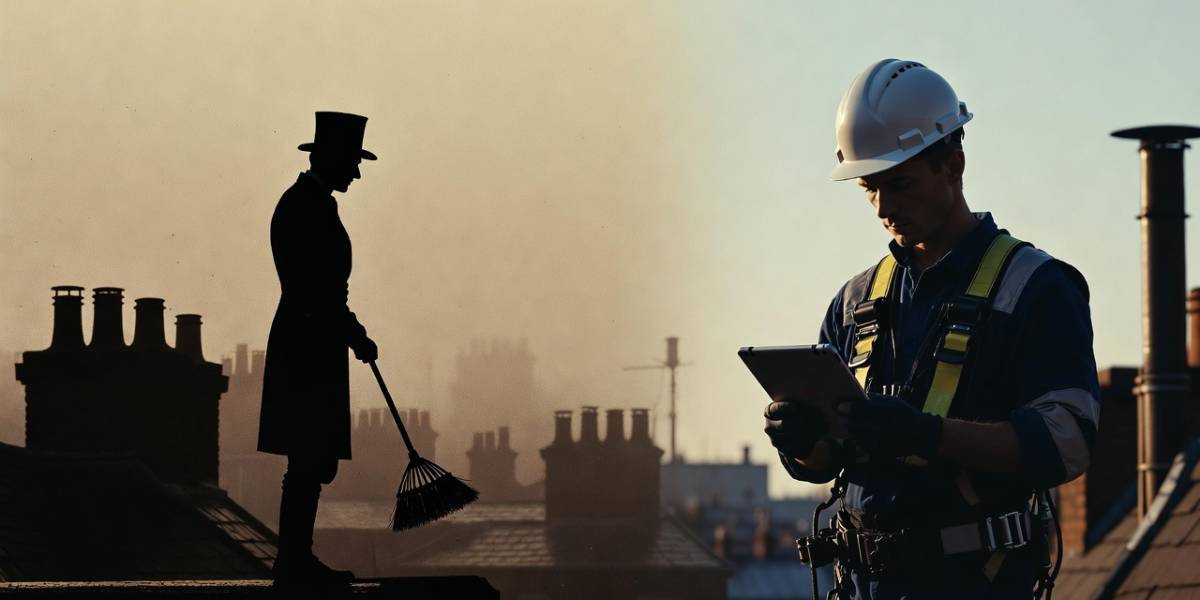
Every trade has a history. Chimney sweeping has an epic. It spans four centuries, multiple continents, child labor reform, the birth of occupational health science, and one of the most stubbornly durable professions in the modern world. The tools have changed. The hats have changed. The fundamental work — keeping flues safe so homes don't burn down — has not.
If you sweep chimneys for a living, you're part of a lineage that stretches back to the ashes of 17th-century London. Here's how the trade got from there to here.
The Great Fire and the Birth of the Trade (1666)
The modern chimney sweeping profession was born out of catastrophe.
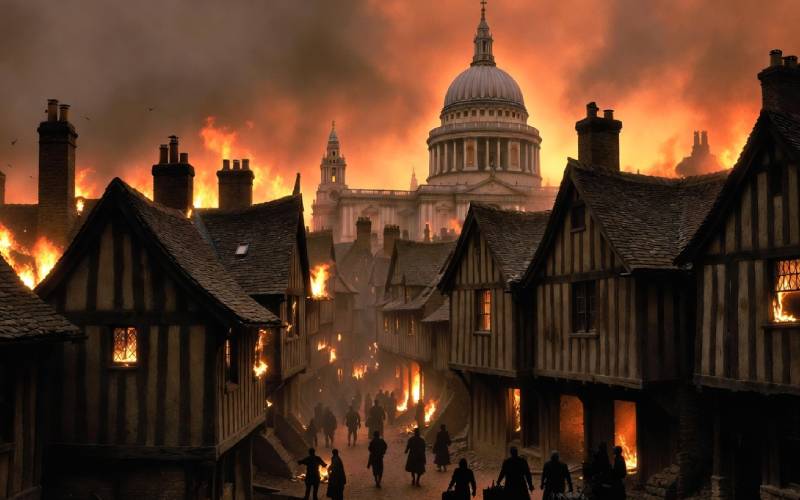
On September 2, 1666, a fire broke out in a bakery on Pudding Lane in London. Over the next four days, it consumed 13,200 houses, 87 parish churches, and most of the civic buildings in the city center. The Great Fire of London didn't just destroy a city — it rewrote the building code for an entire civilization.
In the reconstruction that followed, Parliament mandated new fire-safety regulations. Chimneys had to be built with more complex, angled flue systems designed to contain sparks and reduce fire spread. The problem: these new flues were narrow. Some were built as small as 9 by 14 inches — tight enough that no adult could fit inside them.
These flues still needed cleaning. Creosote buildup didn't care about building codes. And so a new trade was born out of architectural necessity: the chimney sweep.
But those narrow flues also created something far darker — a demand for small bodies that could fit inside them.
The Climbing Boys (1700s–1800s)
For roughly 200 years, the chimney sweeping trade ran on child labor. There is no way to soften this part of the story.
Master sweeps — the business operators of their era — acquired apprentices as young as six years old. These children were often orphans, workhouse wards, or sold into apprenticeship by families too poor to feed them. The arrangement was legal, formalized, and widespread across England and parts of Europe.
The work was exactly what it sounds like. Children climbed inside active flue systems — dark, cramped, vertical passages caked in soot and creosote — and scraped the walls clean with brushes and their own hands. They worked barefoot to grip the brickwork. They worked in near-total darkness. They breathed in soot constantly.
The injuries were routine and brutal. Burns from residual heat in recently used flues. Falls from height when handholds gave way. Chronic joint deformities from years of contorting growing bodies through spaces never meant for human passage. Respiratory disease from constant soot inhalation. And skin conditions that would lead to one of the most important discoveries in medical history.
In 1775, Dr. Percivall Pott, a London surgeon, published a groundbreaking paper identifying scrotal cancer — which he called "chimney sweeps' carcinoma" — as directly linked to prolonged soot exposure. This was the first documented occupational cancer in history. Pott's work didn't just describe a disease. It established the principle that workplace conditions could cause cancer — a concept that would take another two centuries to fully develop into modern occupational health science. Every OSHA regulation, every workplace exposure limit, every safety data sheet traces part of its intellectual lineage back to Pott watching climbing boys die of a preventable disease.
Reform — The Long Fight (1780–1875)
Change came slowly. Agonizingly slowly.
On May 1, 1780, a young climbing boy named George Brewster became trapped in a flue in Wiltshire, England, and suffocated. His death was not unique — children died in flues regularly — but it became a catalyst. Public outrage over Brewster's death helped push Parliament toward the Chimney Sweepers Act of 1788, the first legislative attempt to regulate the trade.
The 1788 act set a minimum apprentice age of eight and required that children be washed at least once a week. It sounds absurd by modern standards. It was barely enforced even by the standards of its own time. Master sweeps ignored it. Magistrates looked the other way. Children continued to climb.
"When my mother sold me while yet my tongue / Could scarcely cry 'Weep! weep! weep! weep!' / So your chimneys I sweep, and in soot I sleep."
— William Blake, "The Chimney Sweeper," 1789
Blake's poem was published just one year after the act that was supposed to fix the problem. Writers understood what legislators couldn't enforce. Charles Kingsley's novel The Water Babies (1863) told the story of Tom, a child chimney sweep, and became one of the most effective pieces of social reform literature in Victorian England. Fiction moved public opinion where legislation had failed.
But here's the timeline that should make you angry: from the first reform act in 1788 to the Chimney Sweepers Act of 1875 — which finally set the minimum working age at 21 and effectively ended the climbing boy system — nearly one hundred years passed. A full century between "this is wrong" and "we're actually going to stop it."
| Year | Event |
|---|---|
| 1666 | Great Fire of London; new building codes create demand for chimney sweeps |
| ~1700s | Climbing boy system becomes widespread across England |
| 1775 | Dr. Percivall Pott identifies first occupational cancer in chimney sweeps |
| 1780 | George Brewster dies in a flue; public outcry intensifies |
| 1788 | First Chimney Sweepers Act — poorly enforced minimum age of 8 |
| 1789 | William Blake publishes "The Chimney Sweeper" |
| 1834 | Further reform act passed — still inadequately enforced |
| 1863 | Charles Kingsley publishes The Water Babies |
| 1875 | Final Chimney Sweepers Act — minimum age set to 21, climbing boys era ends |
The mechanical chimney brush — the tool that eventually made child labor unnecessary — had existed since the early 1800s. Joseph Glass patented an effective design in 1828. The technology to solve the problem existed decades before the political will caught up. That's a pattern worth remembering.
American Chimneys — Colonial Era to Present
While England was debating reform acts, the American colonies were building their own chimney tradition from scratch.
The first chimney sweeps appeared in the American colonies in the 1620s, arriving with the same English building traditions that had created the trade. By the mid-1600s, official sweeps were established in major colonial cities — Boston, New York, Philadelphia. Fire was an existential threat to colonial settlements built largely of wood, and chimney maintenance was taken seriously from the start.
The American trade evolved alongside American housing. Colonial fireplaces gave way to the ornate chimney systems of Victorian mansions, which gave way to the simpler flues of suburban ranch houses. Each era brought new materials, new configurations, and new challenges for the people who maintained them.
But there was a key cultural difference. The European model — particularly in countries like Germany and Scandinavia — leaned toward government regulation. Sweeps were assigned districts. Inspections were mandatory. The trade was organized from the top down.
The American model was always more entrepreneurial. Individual sweeps built individual businesses. Competition drove quality (and occasionally drove it down — a problem the industry still wrestles with). There was no district system, no mandatory inspections in most jurisdictions. You hung out your shingle, you did good work, and you lived or died on your reputation.
That entrepreneurial DNA is still the defining characteristic of the American chimney industry today.
Count Rumford and the Science of Fire
Not all of chimney history is about labor and reform. Some of it is about physics.
Sir Benjamin Thompson — better known as Count Rumford — was a Loyalist who fled the American Revolution, became a Bavarian count (as one does), and along the way revolutionized our understanding of heat transfer and fireplace design. His Rumford fireplace, developed in the late 1700s, featured a tall, shallow firebox with angled sides that radiated heat into the room far more efficiently than the deep, boxy fireplaces of the era.
The Rumford design is still referenced in chimney work today. If you've ever looked at a fireplace and noticed the angled side walls (called "splays" or "covings"), you're looking at Rumford's legacy. His work laid the intellectual foundation for modern hearth science — the understanding that a fireplace isn't just a hole in the wall where you burn things. It's a thermal system with measurable inputs and outputs.
That line of thinking runs directly through to today's NFPA 211 — the Standard for Chimneys, Fireplaces, Vents, and Solid Fuel-Burning Appliances. The document represents centuries of accumulated fire science, from Rumford's experiments to modern combustion research. Every time a sweep references "the standard," they're standing on 200+ years of people trying to figure out how to burn things inside houses without the houses burning down.
The Modern Industry Is Born (1970s–1980s)
For most of the 20th century, chimney sweeping in America was a fragmented, informal trade. There were no national standards for practitioners, no certification programs, no professional organizations to speak of. You learned from someone who learned from someone, and quality varied enormously.
That changed in a single decade.
In 1977, the National Chimney Sweep Guild (NCSG) was founded, giving the trade its first national professional organization. For the first time, sweeps had a collective voice and a structure for sharing knowledge.
Then, in 1978, Mother Earth News published an article proclaiming chimney sweeping as "the best start-on-a-shoestring business." The article landed in the middle of the back-to-the-land movement, when wood stoves were surging in popularity due to the energy crisis. The result: approximately 2,000 new chimney sweeps entered the trade almost overnight. Many had no training. Some had never been on a roof.
The 1978 Mother Earth News surge is a case study in what happens when a trade grows faster than its training infrastructure. Many of those 2,000 new sweeps washed out within a year or two. The ones who stayed became the generation that built the modern industry's institutions — precisely because they'd seen what happened without them.
In 1983, the Chimney Safety Institute of America (CSIA) was established to create a certification standard for chimney professionals. For the first time, there was a nationally recognized credential that meant something — a written exam covering NFPA 211, the International Residential Code, chimney science, and safe work practices. The CSIA Certified Chimney Sweep designation became the industry's gold standard.
A year later, in 1984, the ChimScan inspection camera was invented — the first purpose-built camera system for examining the interior of flue systems. This was a watershed moment. For the first time, sweeps could see inside a flue without physically entering it. They could document conditions with visual evidence. They could show homeowners exactly what they were finding.
The camera didn't just change the inspection process. It changed the business model. Documented findings drove repair work. Visual evidence built customer trust. The inspection camera transformed chimney sweeping from a cleaning service into a diagnostic profession.
The White House Connection
Here's a detail that says something about the reach and durability of this trade: the White House has 28 fireplaces and 12 chimneys. (It originally had 39 fireplaces when it was built.) Those chimneys need sweeping like any others.
NCSG members have swept White House chimneys for decades. Chuck Hall, who served as CSIA President, worked as a government contractor sweeping chimneys at the U.S. Capitol and the Supreme Court. The profession's footprint extends to the highest institutions in the country — literally keeping the fires burning (safely) in the buildings where laws are made and interpreted.
There's something satisfying about that. A trade that started with orphans climbing flues now maintains the chimneys of the most powerful buildings in the nation, performed by certified professionals with cameras, HEPA vacuums, and code books.
Where It's Going
The chimney industry isn't static. It's adapting to a world that's changing how it heats buildings, regulates emissions, and thinks about fire safety.
In Germany, the government projects solid fuel elimination by 2045. German sweeps — who have traditionally been government-regulated district operators — are already transitioning. The new title: Brandschutzbeauftragter, or "fire protector." Same professionals, broader mandate. Instead of just sweeping chimneys, they're becoming general fire safety consultants for buildings.
In Norway, sweeps have been rebranded as fire prevention professionals embedded within municipal fire departments. The chimney is still part of the job, but it's one component of a wider fire safety role that includes building inspections, public education, and emergency planning.
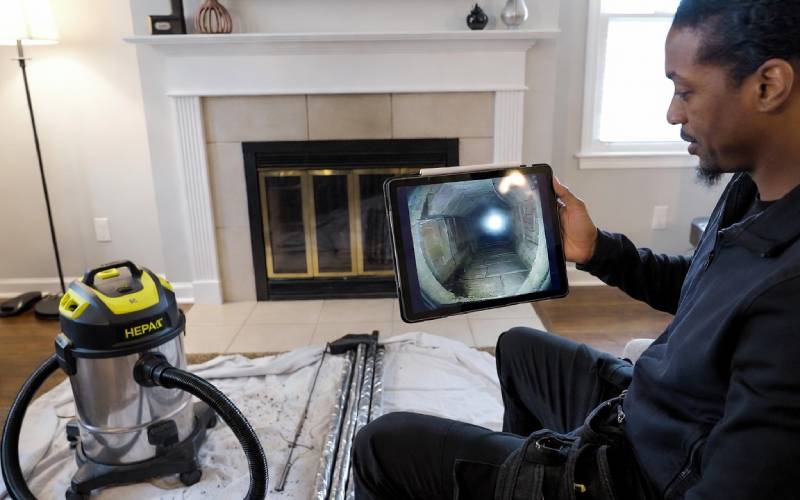
The American market remains characteristically entrepreneurial. No district system. No government mandate to transition. Instead, market forces are driving evolution. Modern American sweeps increasingly use:
- Inspection cameras — from basic borescopes to pan-and-tilt systems that document every inch of a flue
- HEPA vacuum systems — containing soot and particulates instead of spreading them through the customer's home
- Thermal imaging — detecting heat anomalies in chimney structures that aren't visible to the naked eye
- Digital reporting tools — generating professional inspection reports with photos, video, and code references on-site
- Drone technology — for exterior chimney assessment on roofs that are difficult or dangerous to access
But here's the thing that keeps this trade alive in an era of automation and artificial intelligence: every chimney is different.
A chimney built in 1890 has different materials, different construction methods, and different failure modes than one built in 1960. A fireplace that serves a wood-burning stove has different inspection criteria than one connected to a gas insert. A clay tile liner cracks differently than a stainless steel liner corrodes. The variables are enormous, the configurations are infinite, and the consequences of getting it wrong are severe.
You can't automate that judgment. You can't send a robot up a ladder to assess whether a crown crack is cosmetic or structural. You can't replace the experienced eye that looks at a creosote deposit and knows whether it's Stage 1 (brushable), Stage 2 (hardened), or Stage 3 (glazed and dangerous). Every inspection requires a human being who knows what they're looking at.
The chimney services industry in the United States employs an estimated 20,000+ professionals and generates over $1 billion in annual revenue. Despite predictions of decline tied to reduced wood burning, the industry has grown steadily — driven by aging housing stock, stricter insurance requirements, real estate transaction inspections, and increasing awareness of carbon monoxide risks from gas appliances. The trade isn't shrinking. It's evolving.
Four Hundred Years
From the ashes of the Great Fire to certified professionals with cameras and code books. From climbing boys sold into flues to CSIA-credentialed technicians documenting every finding. From folk trade to billion-dollar industry.
The timeline covers some of the worst chapters in labor history and some of the most important milestones in occupational health science. It includes poets, surgeons, engineers, reformers, and — at the center of all of it — the people who actually did the work. The ones who climbed. The ones who scraped. The ones who, today, carry a camera up a ladder and make sure the flue is safe before winter comes.
Four hundred years. The tools changed. The hats changed. The fundamental work didn't.
Someone has to keep the chimney safe. That someone is a professional now. And that's the point of the whole story.
Thinking about joining this 400-year-old trade?
Here's the honest financial reality — what you'll actually earn in years one through three, the seasonal gut punches, and when the money starts to compound.
Read: Is Chimney Sweeping Actually Worth It? →