
Every trade blog sells the dream. "Be your own boss! Unlimited earning potential! Low startup costs!" And then six months in, you're sitting in your van with soot in places you didn't know existed, wondering if you made a terrible decision.
This article is different. We're going to walk through three years of building a chimney sweep business — the actual financial arc, the seasonal gut punches, the physical reality, and the compounding advantages that most people don't see until they're already in it. The numbers here are synthesized from industry benchmarks, trade data, and the operational realities that working sweeps deal with every day.
If you're still reading at the end, you might be cut out for this.
Year One: The $10K Gamble and the Learning Curve
What It Actually Costs to Start
Forget the "start a business for $500" headlines. A chimney sweep business has real equipment requirements, and cutting corners on the wrong items will cost you customers — or worse, get someone hurt.
Here's a honest breakdown of a budget-conscious startup:
| Item | Cost Range |
|---|---|
| Basic tool kit (brushes, rods, HEPA vacuum, drop cloths) | $2,000 – $3,500 |
| Used van or truck | $5,000 – $15,000 |
| Ladders and safety gear | $500 – $1,000 |
| Insurance (first year) | $1,500 – $3,000 |
| Business formation (LLC) + local licenses | $500 – $1,000 |
| Marketing (website, Google Business Profile, cards) | $500 – $2,000 |
| CSIA certification (study materials + exam) | $500 – $800 |
| Total minimum viable startup | $10,500 – $26,300 |
The big variable is the vehicle. A clean used cargo van — Ford Transit, Chevy Express, Ram ProMaster — is the standard. You need something that can carry ladders on top, tools in back, and still look professional parked in a customer's driveway. A beat-up van with your company name on a magnet is better than a slick sports car. Customers want to see someone who looks like they do this for a living.
That HEPA vacuum isn't optional. A regular shop vac blows soot particles back into the air — straight onto your customer's white carpet. A proper HEPA-rated ash vacuum costs $400–$800 and is the difference between looking like a professional and looking like a disaster. This is where you absolutely cannot cheap out.
Year One Revenue: The Honest Number
A first-year solo operator doing primarily cleanings typically brings in $30,000 to $60,000 in gross revenue. After expenses — fuel, insurance, supplies, vehicle maintenance, marketing, certification fees — your take-home is roughly half that.
That's $15,000 to $30,000 in your pocket. Not glamorous. Not "unlimited earning potential." That's the reality of Year One for most people.
Here's why the number is low:
- You're building from zero. No repeat customers. No referral engine. No realtor relationships. Every single customer has to find you for the first time.
- You're slow. Your first twenty cleanings take twice as long as they will by your hundredth. Setup, teardown, customer interaction — it all gets faster with repetition, but Year One is a grind.
- You're seasonal, and you don't know it yet. The phone starts ringing in September when the first cold snap hits. It goes silent in January. If you didn't pre-book customers during summer outreach, you're scrambling.
- You're learning what you don't know. The CSIA exam teaches you the standards. Actual field work teaches you what a cracked flue tile looks like at 3pm when you're tired and the firebox is dark.
An efficient solo sweep doing primarily cleanings can handle 3–4 residential jobs per day. Each cleaning (bundled with a Level 1 inspection, which is industry standard) runs $150–$400 depending on your market. At 3 jobs per day, 4 days a week, 40 weeks of actual working time — that's roughly 480 jobs. At an average of $225 per job, that's $108,000. But in Year One, you're not averaging 3 jobs a day. You're averaging 1–2. That's where the $30K–$60K comes from.
The Seasonal Gut Punch
Nobody warns you about January through May. Well, we're warning you now.
The chimney business runs on a lopsided calendar. Here's how revenue actually distributes across the year:
| Quarter | % of Annual Revenue | What's Happening |
|---|---|---|
| Q1 (Jan–Mar) | 10–15% | Slowest quarter. Emergency calls, some repairs. |
| Q2 (Apr–Jun) | 15–20% | Spring masonry repairs. Early cleaning bookings. |
| Q3 (Jul–Sep) | 20–25% | Ramping up. September is when it kicks in. |
| Q4 (Oct–Dec) | 40–55% | Peak season. This quarter makes or breaks your year. |
Read that again. Nearly half your annual income arrives in three months. If you're not financially prepared to survive a lean spring with minimal revenue, you won't make it to the next fall rush.
The sweeps who survive Year One either have savings to ride out the slow months or they hustle hard on off-season services — dryer vent cleaning ($100–$250 per job), chimney cap installations, waterproofing, small masonry repairs. The ones who sit around waiting for the phone to ring in February don't make it to Year Two.
Year Two: Repeat Customers and the Inspection Revenue Unlock
The Repeat Customer Flywheel
Something changes in Year Two that fundamentally shifts the economics: customers you served last year call back.
NFPA 211 requires chimneys to be inspected at least annually. If you did good work, communicated clearly, and left a professional impression, a large percentage of your Year One customers will book again without you spending a dime on marketing. The best operators book next year's appointment before they leave the customer's home. That single habit — "Let me get you scheduled for next fall before I head out" — is the most effective retention tactic in the trade.
The average chimney service customer stays with the same sweep for 5–8 years if properly retained. At $200–$350 per annual cleaning, plus the occasional repair, each retained customer represents $1,500–$4,000 in lifetime value. And their acquisition cost for Year Two and beyond? Zero.
Set up a simple annual reminder system from Day One. Automated email or text message 11 months after their last service: "Your annual chimney inspection is due next month." This one system — which costs almost nothing to run — is what separates sweeps who build a book of business from sweeps who are constantly chasing new customers.
Adding Inspections to Your Revenue Mix
If Year One was about learning to clean efficiently, Year Two is about learning to see.
Every cleaning should include a Level 1 inspection — a visual assessment of the readily accessible parts of the chimney system. But once you invest in a chimney inspection camera ($600–$2,000 for a professional-grade unit), you can offer Level 2 inspections. And Level 2 inspections change everything.
A Level 2 inspection is required by NFPA 211 whenever a property changes hands, an appliance is replaced, or there's been a chimney fire or significant weather event. That means every real estate transaction involving a fireplace is a potential Level 2 job — at $300–$700 per inspection. Build relationships with 5–10 active real estate agents in your area and you have a steady pipeline of Level 2 work that runs year-round, independent of heating season.
But the real money isn't in the inspection fee itself. It's in what the inspection reveals.
The Deficiency Pipeline
Every inspection is a diagnostic. And every diagnostic reveals conditions that need attention. A cracked crown. A missing cap. Deteriorated mortar joints. An unlined flue. A damper that doesn't seal. These aren't upsells — they're documented findings backed by photos, video, and code references.
Here's how the revenue breakdown shifts when you start converting inspection findings into repair work:
| Service Category | Cleaning-Only Business | Full-Service Business |
|---|---|---|
| Cleaning + Level 1 | 60–70% | 25–35% |
| Level 2 inspections | 5–10% | 10–15% |
| Repairs (caps, dampers, crowns, flashing) | 15–25% | 25–35% |
| Major installations (liners, rebuilds) | 5–10% | 15–25% |
| Other (dryer vents, gas service) | 5–10% | 5–10% |
The cleaning-only business plateaus. The full-service business compounds. That's the Year Two insight that most people don't get until they're living it.
Year Two Revenue: The Trajectory
A second-year operator who retained 40–60% of Year One customers, added Level 2 capabilities, and started converting findings into repair work typically sees $60,000 to $120,000 in gross revenue. Take-home: $30,000 to $60,000.
That's a meaningful jump. And it's driven by three things you didn't have in Year One: returning customers, inspection capability, and repair skills.
Year Three: The Referral Engine and Six-Figure Territory
Compounding Credibility
By Year Three, something has happened that you can't buy and can't fake: you've built a reputation.
Your Google Business Profile has dozens of 5-star reviews. Your branded van is a familiar sight in your service area. Real estate agents call you directly for Level 2 inspections. Homeowners refer their neighbors. You're the sweep their friends recommended.
Customer acquisition cost drops dramatically. In Year One, you might spend $50–$150 to acquire each customer through ads. By Year Three, the majority of your new customers come from referrals and repeat business — effectively free acquisition.
Diversified Revenue Streams
The established sweep doesn't just clean chimneys. The service menu by Year Three might include:
- Annual cleaning + Level 1 inspection — Your bread and butter, now running like clockwork with 200+ repeat customers.
- Level 2 inspections — Real estate transactions, post-chimney-fire evaluations, appliance changes. $300–$700 each.
- Chimney cap installation — $150–$500 installed. You carry popular sizes in stock.
- Crown repair and waterproofing — $150–$800 per job. High-margin work you can identify during routine cleaning.
- Damper replacement — $400–$1,500 for top-mount dampers that double as rain caps.
- Liner installation — $625–$7,000 depending on type, size, and length. The big-ticket service.
- Dryer vent cleaning — $100–$250 per job. Easy add-on: "While I'm here, want me to clean your dryer vent?"
- Gas appliance servicing — With NFI Gas certification. Lower-intensity work that fills the off-season.
An established solo operator running a full-service chimney business typically generates $100,000 to $200,000 in annual revenue. High performers — solo operators who've optimized their schedule, diversified their services, and built strong referral networks — hit $150,000 to $250,000. The critical insight: cleaning-only businesses plateau around $80,000–$120,000. It's the repair and installation revenue that pushes past the ceiling. Profit margins on cleaning run 70–80% (mostly labor), while liner installations are 40–55% but at a much higher ticket price.
The Math That Matters
Let's run a realistic Year Three scenario for a full-service solo operator in a mid-range market:
| Revenue Source | Volume | Avg. Price | Annual Revenue |
|---|---|---|---|
| Cleaning + Level 1 | 350 jobs | $250 | $87,500 |
| Level 2 inspections | 30 jobs | $450 | $13,500 |
| Repairs (caps, crowns, dampers) | 60 jobs | $400 | $24,000 |
| Liner installations | 8 jobs | $2,500 | $20,000 |
| Dryer vent cleaning | 80 jobs | $150 | $12,000 |
| Total gross revenue | $157,000 |
Net profit for a solo operator at this level — after vehicle costs, insurance, supplies, marketing, and certification fees — typically runs 25–40%. That's $39,000 to $63,000 in take-home pay, working for yourself, setting your own schedule, and building equity in a business you own.
Not life-changing wealth. But solid middle-class income in a trade that can't be outsourced, automated, or replaced by AI. Every house with a chimney needs someone to climb up there, look inside, and know what they're seeing.
The Parts Nobody Talks About
The Physical Reality
This is not desk work. Your body is your primary tool, and it takes a beating.
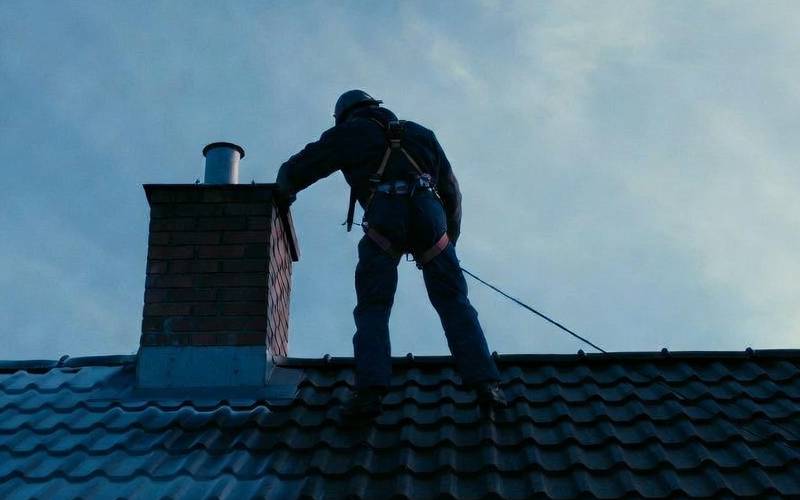
- Roof work. You're climbing extension ladders and walking on rooftops in all weather. Falls from height are the most common serious injury in the trade. Proper fall protection isn't optional — it's survival equipment.
- Soot exposure. Chimney sweeps have documented elevated rates of lung cancer, bladder cancer, and respiratory illness from long-term soot and creosote exposure. Proper respiratory protection — N95 at minimum, PAPR for heavy jobs — is non-negotiable. This isn't something to be casual about.
- Repetitive strain. Pushing rods, carrying vacuums, contorting yourself inside fireboxes. Knee pads, proper lifting technique, and staying in reasonable physical condition matter more every year.
- Weather dependence. Rain cancels roof work. Snow makes ladders dangerous. Extreme cold makes everything harder. Your schedule is at the mercy of conditions you can't control.
Asbestos is a real and present hazard. Many older chimneys were insulated with asbestos-containing materials. Disturbing these materials without proper precautions can cause serious illness. Before you start a chimney business, understand asbestos identification and proper procedures. This is an area where ignorance is genuinely dangerous.
The Stigma Factor
You will smell like a campfire most days. Your hands will have permanent dark creases. You'll get looks at the grocery store when you stop on the way home. People will make Mary Poppins jokes. (They never stop.)
But here's the thing most people outside the trades don't understand: there is a deep satisfaction in skilled manual work that produces a tangible, visible result. You show up, you make something safer, and you leave knowing you did real work that mattered. No meetings about the meeting. No quarterly review of the strategic roadmap. You cleaned a chimney and protected a family from a house fire.
The Scam Problem
The chimney industry has a well-documented problem with unlicensed, uncertified operators running scams. The playbook: advertise a $49 chimney cleaning, show up, "discover" a laundry list of problems, and pressure-sell thousands of dollars in unnecessary repairs.
This hurts every legitimate sweep. Customers are primed to be suspicious when you find real problems during an honest inspection. Your best defense is thorough documentation — photos, video, code references — and a calm, transparent presentation. "Don't take my word for it. Here's what the camera shows. Here's what the NFPA standard says about this condition."
Certification matters partly for this reason. When a customer searches "chimney sweep near me" and finds a CSIA-certified sweep with dozens of Google reviews versus some guy on Craigslist offering $49 cleanings, the certified professional wins. Not always. But increasingly.
So... Is It Worth It?
There's no universally right answer. But here are the honest conditions under which chimney sweeping is a genuinely good career path:
- You can tolerate physical work and heights. If you're afraid of ladders, this isn't your trade. That's not a flaw — it's just a filter.
- You have enough savings to survive a lean first year. Six months of living expenses, minimum. You're building a business, and businesses take time to generate revenue.
- You're willing to earn certifications and learn the standards. The CSIA exam requires real study — NFPA 211, the International Residential Code, chimney science. This isn't a trade you can fake.
- You live in an area with older housing stock. Homes built before 1990 almost always have traditional chimneys. New construction trends toward gas or electric — fewer chimneys, less demand. Markets with older homes have more work.
- You want to own your work. No boss, no corporate structure, no office politics. Just you, your tools, and the quality of your service. For certain people, that autonomy is worth more than any salary.
The three-year arc is real. Year One is lean and humbling. Year Two is where the economics start to work. Year Three is where it becomes a legitimate business that generates real income while building something you own.
Most people who make it past Year One don't leave. There's a reason for that.
Ready to get serious?
The first real step is understanding which certifications actually matter — and which ones are a waste of money.
Read: The Certifications That Actually Matter →